Showing posts with label Flash Cards. Show all posts

Huff: ECG Workout: Exercises in Arrhythmia Interpretation 6th Edition

This outstanding text and workbook is the leading reference for students, practicing nurses, paramedics, and other health professionals learning ECG interpretation. Thoroughly updated with new figures and easy-to-follow text, ECG Workout is an excellent guide to rhythm analysis that builds on the student's knowledge in a step-by-step fashion to broaden understanding of essential ECG concepts and hone the skills necessary to confidently and accurately interpret ECG waveforms. Coverage includes cardiac anatomy and physiology, electrophysiology, waveforms, arrhythmias, and pacemakers.

The book includes over 600 ECG strips illustrating a wide variety of conditions, end-of-chapter practice tests, a comprehensive posttest, a glossary, and answer keys at the back of the book. Handy bonus flashcards provide additional practice. The latest ACLS guidelines are also included.


Get the knowledge you need to meet the challenges of ECG interpretation with:
  • Over 600 actual-sized practice rhythm strips – more than any other guide on the market!
  • Clear, thorough overviews of anatomy, physiology, and electrophysiology.
  • Identification of principal waveform components and scores of illustrations for essential ECG concepts.
  • Easy, five-step method for analyzing any rhythm strip.
  • Chapters covering the most common arrhythmias, - sinus arrhythmias, atrial arrhythmias, junctional arrhythmias and AV blocks, ventricular arrhythmias.
  • Bundle-branch blocks, pacemakers – all with typical waveforms.
  • Hardwire and telemetry monitoring equipment and troubleshooting tips.


Plus …
  • Comprehensive post-test to evaluate what you’ve learned.
  • Handy pocket ECG conversion card for more precise heart rate calculation.
  • Online PowerPoint® chapter reviews and flash cards.


New in this edition
  • NEW: Skill-building approach to learning, with new "Skill builder" practice rhythm strips in select chapters.
    • Chapter 7 (Atrial Arrhythmias) includes 25 mixed practice strips - sinus and atrial strips - helping students distinguish between the two types of rhythms
    • Chapter 8 (Junctional Arrhythmias and AV Blocks) includes a mixture of additional practice strips - atrial, junctional, and heart block - building on information from the preceding chapter
    • Chapter 9 (Ventricular Arrhythmias and Bundle Branch Blocks) goes one step further to include a mix of yet more practice strips - sinus, atrial, junctional, heart block, and ventricular - encouraging students to apply recently learned concepts and skills
  • NEW: Chapter 10 (Pacemakers) extensively revised to include permanent pacemaker strips and temporary venous strips


Contents
  1. Anatomy and physiology of the heart
  2. Electrophysiology
  3. Waveforms, intervals, segments, and complexes
  4. Cardiac monitors
  5. Analyzing a rhythm strip
  6. Sinus arrhythmias
  7. Atrial arrhythmias
  8. Junctional arrhythmias and AV blocks
  9. Ventricular arrhythmias and bundle-branch block
  10. Pacemakers
  11. Posttest
  12. Appendices: Answer keys to Practice strips and Skill-building strips
  13. Glossary
  14. Electrocardiographic conversion table for heart rate


About the Author
  • Jane Huff RN, CCRN, Education Coordinator, Critical Care Unit, Arrhythmia Instructor, Advanced Cardiac Life Support (ACLS) Instructor, White County Medical Center, Searcy, AR.


Product Details

  • Paperback: 384 pages
  • Publisher: Lippincott Williams & Wilkins; Sixth edition (2011)
  • Language: English
  • ISBN-10: 1451115539
  • ISBN-13: 978-1451115536
  • Product Dimensions: 10.8 x 8.3 x 1 inches
List Price: $49.95 


Wheeler's Dental Anatomy, Physiology and Occlusion 9th Edition with CD-ROM and Flash Cards

Now in full color, this essential text features a visually oriented presentation of dental anatomy, physiology, and occlusion the foundation for all of the dental sciences. Coverage includes discussions of clinical considerations, dentitions, pulp formation, and the sequence of eruptions. In addition to detailed content on dental macromorphology and evidence-based chronologies of the human dentitions, this edition also includes flash cards, an updated Companion CD-ROM, and Evolve resources that make this text a comprehensive resource for dental anatomy.

Key Features
  • Understand the standards of tooth formation and apply them to clinical presentations with the Development and Eruption of the Teeth chapter.
  • Focus on the functions and esthetics of disorders you’ll encounter in daily practice with content on TMJ and muscle disorders.
  • Get a concise review of dentition development from in-utero to adolescence to adulthood with the appendix of tooth morphology.

New to This Edition
  • All line drawings and essential photos have been replaced with full-color pieces.
  • Sharpen your knowledge with interactive learning tools and expanded content on the Companion CD-ROM including study questions, 360-degree rotational tooth viewing, and animations.
  • Test your knowledge on labeling, tooth numbering, and tooth type traits and prepare for Board exams with flash cards.
  • Find even more study opportunities on the Evolve website with a PowerPoint presentation, flash cards, a test bank, and labeling exercises.

Contents 
  • 1. Introduction to Dental Anatomy
  • 2. Development and Eruption of the Teeth
  • 3. The Primary (Deciduous) Teeth
  • 4. Forensics, Comparative Anatomy, Geometries, and Form and Function
  • 5. Orofacial Complex: Form and Function
  • 6. The Permanent Maxillary Incisors
  • 7. The Permanent Mandibular Incisors
  • 8. The Permanent Canines: Maxillary and Mandibular
  • 9. The Permanent Maxillary Premolars
  • 10. The Permanent Mandibular Premolars
  • 11. The Permanent Maxillary Molars
  • 12. The Permanent Mandibular Molars
  • 13. Pulp Chambers and Canals
  • 14. Dento-Osseous Structures, Blood Vessels and Nerves
  • 15. The Temporomandibular Joints, Teeth, and Muscles and their Functions
  • 16. Occlusion
  • 17. Flash Cards Appendix 

About the Author
Stanley J. Nelson, DDS, MS, Professor and Co-Chair Clinical Sciences Education, University of Nevada-Las Vegas, School of Dental Medicine, Las Vegas, NV.


Product Details

  • Hardcover: 368 pages
  • Publisher: Saunders; 9 edition (2010)
  • Language: English
  • ISBN-10: 1416062092
  • ISBN-13: 978-1416062097
  • Product Dimensions: 11.1 x 8.7 x 1 inches
List Price: $98.95

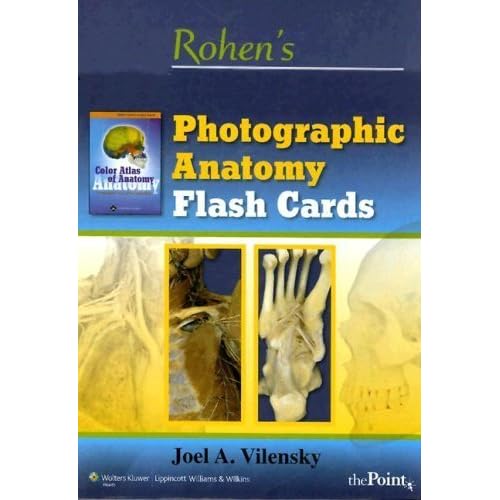
Rohen's Photographic Anatomy Flash Cards

This set of 220 flash cards were developed with the primary aim of helping health profession students prepare for a practical exam in a typical medical gross anatomy and/or neuroanatomy course. Although there are many anatomy flash card sets available, none are based on photographs of cadaver dissections. The advantage of using photographic images rather than drawings for preparing for a practical exam seems self-evident. 

All the photographs in this flash card set were derived from the sixth edition of Color Atlas of Anatomy: A Photographic Study of the Human Body by Johannes W. Rohen, Chihiro Yokochi, and Elke Lütjen-Drecoll (2006). The photographs in that atlas are exquisite in their detail. 

Before trying to identify a structure, the student should first become oriented—that is, determine what is medial, lateral, superior, inferior, anterior, and posterior. The student should use the same approach when taking the exam itself. These cards lack the three-dimensional definition that cadavers offer; thus, identifying structures on these cards is probably harder than identifying the identical structures on a cadaver. However, the dissections used for these photographs are so good that this liability is not significant and is equally prevalent on flash cards based on drawings. 

The front of each card typically has three or four structures to identify. The correct answers are identified on the back of the card. Further, each answer includes some important anatomical characteristic of that structure that may help the student identify it more readily or answer a written question about it. Also on the back of the card is the page number of the atlas that contains the image shown on the front. Thus, the student can easily obtain more information about each image.
Performing well on a practical exam is a skill that some students find difficult to master. Students will find these cards helpful in acquiring that skill.
 

Medical Lecture Note Copyright © 2011